Puffin Shop
Sculptural installation with 2,470 irregularly shaped textile puffin teddies, each approx. 12 × 6 × 5 cm; nine untreated solid pine IKEA Ivar shelf units fitted with nine shelves and secured at the back with galvanized cross brace, each unit approx. 237 × 83 × 30 cm, arranged in three triangles made of three shelf units each, each arrangement approx. 237 cm height and 120 cm diameter; soundtrack and original score by Joseph Marzolla. 2019.
The Puffin Shop is a unique piece and part of the collection of the Living Art Museum in Reykjavik, Iceland.
From the Keep Frozen project, 2010–2021.
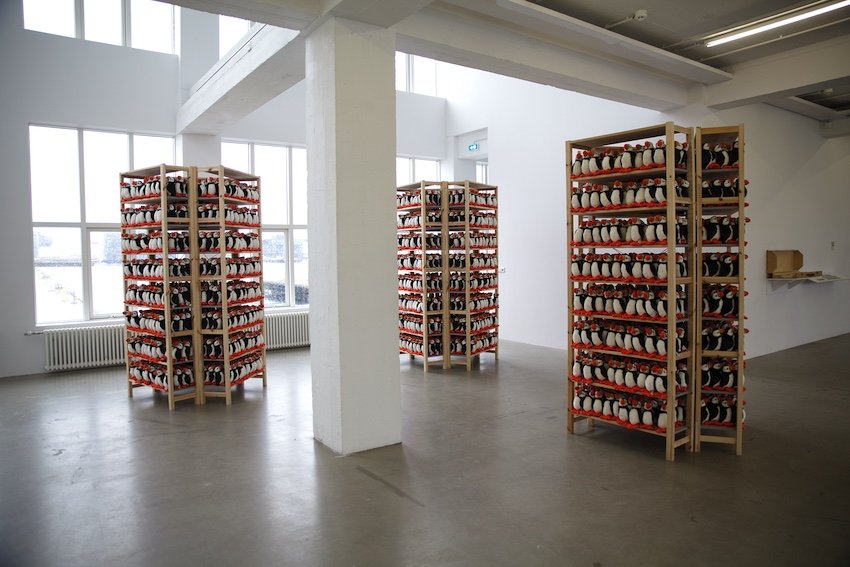
Installation view 'New Acquisitions: received, remade, replaced', The Living Art Museum, Reykjavik, 2025. Curator: Jenny Barrett.
The Puffin Shop was created as part of a larger installation All is Full of Love curated by Jonatan Habib Engqvist at Künstlerhaus Bethanien in 2019. In his curatorial text he wrote: ‘‘.. Connecting the three most important industries in Icelandic modern times the artist positioned herself as the evolving figure of the artist as a puffin while underlining the manual labour that prevails, in spite of shifting class structures… A post-bankruptcy Icelandic economy came to rely heavily on the creative industries and entrepreneurial tourism. To cater for visitors, gentrification is now occurring at all levels of the community, not-least with so-called 'puffin shops' serving every Instagram-able tourist need while the harbour areas are being transformed into ‘authentic’ leisure centers ‘with a view’…´
As part of the exhibition Ann-Sofie Gremaud, associate professor at University of Iceland, held a seminar based on theories she examined in her PhD thesis and that can shed a light on the Artist as a Puffin work. In her essay she claims that “norientalist” stereotypes can be viewed as a process of European-colonial reciprocal identity formation by referring to Hegel who has argued how identity processes rely heavily on mutual confirmation: The center needs to define a periphery (an “other”) in order to define itself. To Gremaud Iceland has played a vital role as “the other place”, where explosive natural power has been juxtaposed to the long history of European culture. Historical colonial association with the natural state has led to Icelanders being perceived as more original, authentic, unspoiled or even uncivilized and barbaric. Reactions to that perception have sometimes included its rejection, whilst at others, embraced it and so been complicit in self-exoticisation.

Installation view ‘All is Full of Love’, Künstlerhaus Bethanien, Berlin, 2019. Curator: Jonatan Habib Engqvist.

Installation view ‘All is Full of Love’, Künstlerhaus Bethanien, Berlin, 2019. Curator: Jonatan Habib Engqvist.

Installation view ‘All is Full of Love’, Künstlerhaus Bethanien, Berlin, 2019. Curator: Jonatan Habib Engqvist.
In 2025 Distanz Verlag published a monograph on the Keep Frozen research project titled Rhythm of Labor. On the occassion Katla Kjartandsdottir, then PhD candidate in Cultural Studies and sessional teacher at the University of Iceland, was commissioned to write an essay about The Artist as a Puffin. The text approaches the series through the exhibition All is Full of Love.
The German art critic Julia Gwendolyn Schneider, the editor of the monograph, introduced Kjartansdottir essay with these words: ‘‘As early as 2006, when puffins were far from being the ultimate tourism symbol in Iceland, Guðnadóttir sensed a paradigm shift in the bird’s significance and began developing a performative persona. Kjartansdóttir unpacks how the “small, cute, and cuddly” image of the puffin is creatively deconstructed. She contextualizes the puffin works in relation to the cultural and socio-economic developments in Iceland at the time they were created and updates their meaning by illuminating the puffin’s role as a harbinger of potentially grim ecological messages.’
''Thinking through and with the Atlantic Puffin''
by Katla Kjartansdottir
For centuries the Atlantic puffin was hunted and used as a food source, especially among people who lived in close contact with large puffin colonies. However, according to recent research the puffin population in Iceland has declined by about 70% since 1995, and the hunting of puffins was subsequently deemed unsustainable.1 This severe decline of puffins is thought to be partly caused by global ecological challenges such as climate change, increased oil and plastic pollution, waste disposal and warming of sea temperatures. Other man-made threats include chronic over-fishing, mining, industrial and military effluents. These challenges have harshly impacted their living conditions and the availability of vital food sources.2 According to the IUCN European red list of threatened species, published in 2021, the Atlantic puffin is currently listed as “endangered.”3 Despite these facts, puffins continue to be hunted in Iceland in accordance with local bird hunting legislations in certain coastal areas and islands. In some Icelandic restaurants, puffin meat can even still be found on the menu and among visiting tourists, who are aiming for “exotic” food experiences, it is quite popular.
One of the causes of increased oceanic pollution is the massive growth of tourism in Iceland, with heavily polluting cruise liners coming closer and closer to the puffin colonies and their nesting burrows.4 The sudden growth of tourism traces back to 2008, when the reverberations of the global financial crisis hit Iceland especially hard, leading to a near-collapse of the economy. As the nation looked for ways to recover economically, attention increasingly turned towards the potential for tourism, culminating in remarkable growth within a few years. In relation to this shift, the Atlantic puffin was taken up as a major cultural symbol and one of the key figures in Iceland’s national imaginary. The bird undoubtedly served the growing demand of the tourist industry for the rare and the exotic. But also the growing niche of what has been named “last chance” or “doom” tourism—a travel trend where tourists explicitly seek out vanishing landscapes and/or seascapes.5
Interestingly, the new role and tremendous visual presence of the puffin within the growing tourism sector came as a complete surprise to many local Icelanders who did not quite understand this popularity. The bird had hardly ever appeared in Icelandic mythology or folklore, where other birds like the raven are quite common. At the time Icelandic ethnologist and tour guide Árni Björnsson commented in a local newspaper that this popularity was purely caused by foreign tourists who seemed to have enormous interest in the bird.6 In the following years puffin imagery became notoriously widespread in tourism promotion material: postcards, advertisements, and the new souvenir shops were filled with all kinds of puffin memorabilia, such as puffin mugs, puffin keyrings, or puffin pajamas.7 The puffin quickly became the ultimate tourism symbol and a very active more than human player in constructing the image of an “exotic” Iceland, with its main emphasis on pure, wild, untouched nature and vigorous wildlife.8
Cute and Cuddly Chimera
For close to twenty years, Hulda Rós Guðnadóttir has delved deeply into the meaning of the intricate layers surrounding the imagery of the Atlantic puffin. As early as 2006, when puffins were not yet the ultimate tourism symbol in Iceland, Guðnadóttir sensed a paradigm shift in the bird’s significance and began to develop a performative persona—a human-puffin chimera. The resulting photographic work was aptly titled Artist as a Puffin (2006) and depicted a feminine human figure in a flowing red gown, high-heels, and a large puffin mask with eyes resembling two glistening diamonds. The character subtly echoed a cute puffin-human hybrid Guðnadóttir had spotted when visiting a bookshop in Akureyri, a town in North Iceland.
In the work, which was first shown as part of Guðnadóttir’s mixed-media solo exhibition at Reykjavík’s Sequences biennale in 2006, the artist morphs into the Atlantic puffin and blurs conventional human/animal boundaries. The Artist as a Puffin engaged critically with the image production and mystification of Icelandic artists as cute, weird, and elf-like figures with exotic/erotic undertones, which had been evolving around this time, particularly, on the pages of the British music press. The “small, cute and cuddly” image of the puffin is creatively dismantled and questioned, while a more complex and critical depiction emerges as the artist situates herself in the position of the bird. From that starting point, Guðnadóttir attempts to think through and with the puffin to raise questions regarding urgent societal and ecological challenges.
All is Full of Love
In 2019 Guðnadóttir remade the puffin image for her solo mixed-media installation All is Full of Love at Künstlerhaus Bethanien in Berlin. This time she added an image sequence of thirteen performative poses that nod to chirpy old-fashioned pin-up poster girls, emphasizing the performative aspect of the work as “a game of re-appropriation [sic], of taking control over the creation of meaning of the symbols representing one’s own identity.”9
Another sculpture is Thinking Like a Mountain. Thinking Like a Mall (2019) comprised of 450 puffin teddies lying in a heap on a wooden table next to Puffin Shop. The second half of the work’s title is borrowed from the book Thinking Like a Mall: Environmental Philosophy after the End of Nature (2016) written by Steven Vogel, who argues provocatively that environmental philosophy, in its ethics, should no longer draw a distinction between the natural and the artificial. By directly confronting puffin imagery as a mass-produced tourist keepsake and tangible symbol of contemporary Icelandic cultural identity, the sculptures delved deeper into issues surrounding the commodification of ethnic and cultural identities associated with the massive growth of the tourism industry in Iceland and beyond.
Lastly, on the upper floor, the All is Full of Love installation included the single-channel video work Material Puffin (2014) that had initially been exhibited as a component of another mixed-media installation at Thoka Gallery during the Reykjavík Arts Festival in 2014. In this video the “artist as a puffin” wakes up, a bit bewildered, at the midtown harbor area in Reykjavík and sets out to explore the semi-industrial area and its many fascinating objects. In a central scene the figure sprays glittering gold into the ocean with a gas pump, evoking thoughts of oil use and oil pollution that accompany ship traffic around the world, as well as its often disastrous effects for seabirds such as the Atlantic puffin.10 The scene sheds light on the evolving role of the Atlantic puffin as a harbinger, capable of conveying somber ecological messages about the precarious state of our shared environment.
At their core, the “artist as a puffin” artworks illuminate the evolving dynamics of cross-species interactions, intricately weaving together the entanglements between humans and animals. They delve into the shifting role of the Atlantic puffin, portraying it not only as a significant cultural symbol, but also as a vulnerable life form within an era marked by climatic collapse and the relentless progression of the sixth mass extinction.11 The precarious state of our shared environment affects the living conditions not only of puffins, but also of numerous other species, including our own. Furthermore, Guðnadóttir metaphorically expands the questions surrounding the image production of the Atlantic puffin to Icelandic women and artists, who likewise have been increasingly promoted and contextualized as (seductive) fairy-tale characters or even as Disney-themed park figures—characters that have fitted quite well within the longstanding image production of Iceland as dynamic and exotic space, full of creative eccentrics, attractive women, untouched nature, vibrant nightlife, and, of course, vigorous animal wildlife.12
Through the playful and dynamic figure of the “artist as a puffin,” Guðnadóttir sheds a complex light on the urgent matters of our times, both locally and globally. These include the commodification of cultural identities linked to the massive growth of tourism, ruthless exploitation of nature and wild animals that has led to ecological devastation. And, not least, the significant role of artists within these ongoing social, cultural, ecological, and economic developments.
- Katla Kjartandsdottir
1 Erpur Snær Hansen, “Ársskýrsla Review, 21. árg., nr. 1 (1999), bls. 83. 2022,” Náttúrustofa Suðurlands, May 19, 2022. Retrieved from [link] (accessed June 22, 2024).
2 Erpur Snær Hansen et al., “Centennial Relationships between Ocean Temperature and Atlantic Puffin Production Reveal Shifting Decennial Trends,'' Global Change Biology, vol. 27, no.16, (August 2021), pp.. 3753 – 3764.
3 “Atlantic Puffin: Fratercula Arctica (Europe Assessment), The IUCN Red List of Threatened Species 2021,” BirdLife International (2021). Retrieved from [link] (accessed May 10, 2024).
4 “Látrabjarg og nágrenni: Landvarsla, ástand innviða og staða friðlýsingar,” Umhverfisstofnun, (2017). Retrieved from [link] (accessed May 7, 2024).
5 Harvey Lemelin et al., eds., Last Chance Tourism: Adapting Tourism Opportunities in a Changing World (London: Routledge, 2012).
6 “Iceland’s Most Precious Bird,” Iceland Monitor, September 28, 2015. Retrieved from [link] (accessed March 16, 2024.
7 Katrín Anna Lund et al., “Puffin Love: Performing and Creating Arctic Landscapes in Iceland through Souvenirs,” Tourist Studies, vol. 18, no. 2 (June 2018), pp. 142–158.
8 Katla Kjartansdóttir and Kristinn Schram, “Mobilizing the Arctic: Polar Bears and Puffins in Transnational Interplay,” in Kristín Loftsdóttir et al, eds. Mobility and Transnational Iceland: Current Transformations and Global Entanglements (Reykjavík: University of Iceland Press, 2020), pp. 209–229.
9 Hulda Ros Guðnadóttir quoted in: Kjartansdóttir and Schram, “Mobilizing the Arctic,” p. 223.
10 “The Much Beloved Atlantic Puffin in Graver Danger than Estimated,” United Nations: Regional Information Center for Western Europe, May 22, 2023. Retrieved from [link] (accessed March 16, 2022).
11 Elizabeth Kolbert, The Sixth Extinction: An Unnatural History (New York: Holt Paperbacks, 2014).
12 See, for example Katla Kjartansdóttir, “Remote, Rough and Romantic: Contemporary Images of Iceland in Visual and Textual Narrations,” in Sverrir Jakobsson, ed., Images of the North: Histories—Images—Ideas, Studia Imagologica: Amsterdam Studies on Cultural Identity, vol. 14 (Leiden: Brill Academic Publishers, 2009), pp. 271–280; Kristín Loftsdóttir et al., “Trapped in Clichés: Masculinity, Films and Tourism in Iceland,” Gender, Place and Culture: A Journal of Feminist Geography, vol. 24, no. 9 (September 2017), pp. 1225–1242.
4 “Látrabjarg og nágrenni: Landvarsla, ástand innviða og staða friðlýsingar,” Umhverfisstofnun, (2017). Retrieved from [link] (accessed May 7, 2024).
5 Harvey Lemelin et al., eds., Last Chance Tourism: Adapting Tourism Opportunities in a Changing World (London: Routledge, 2012).
6 “Iceland’s Most Precious Bird,” Iceland Monitor, September 28, 2015. Retrieved from [link] (accessed March 16, 2024.
7 Katrín Anna Lund et al., “Puffin Love: Performing and Creating Arctic Landscapes in Iceland through Souvenirs,” Tourist Studies, vol. 18, no. 2 (June 2018), pp. 142–158.
8 Katla Kjartansdóttir and Kristinn Schram, “Mobilizing the Arctic: Polar Bears and Puffins in Transnational Interplay,” in Kristín Loftsdóttir et al, eds. Mobility and Transnational Iceland: Current Transformations and Global Entanglements (Reykjavík: University of Iceland Press, 2020), pp. 209–229.
9 Hulda Ros Guðnadóttir quoted in: Kjartansdóttir and Schram, “Mobilizing the Arctic,” p. 223.
10 “The Much Beloved Atlantic Puffin in Graver Danger than Estimated,” United Nations: Regional Information Center for Western Europe, May 22, 2023. Retrieved from [link] (accessed March 16, 2022).
11 Elizabeth Kolbert, The Sixth Extinction: An Unnatural History (New York: Holt Paperbacks, 2014).
12 See, for example Katla Kjartansdóttir, “Remote, Rough and Romantic: Contemporary Images of Iceland in Visual and Textual Narrations,” in Sverrir Jakobsson, ed., Images of the North: Histories—Images—Ideas, Studia Imagologica: Amsterdam Studies on Cultural Identity, vol. 14 (Leiden: Brill Academic Publishers, 2009), pp. 271–280; Kristín Loftsdóttir et al., “Trapped in Clichés: Masculinity, Films and Tourism in Iceland,” Gender, Place and Culture: A Journal of Feminist Geography, vol. 24, no. 9 (September 2017), pp. 1225–1242.